
Modified Hügelkultur Technique for Forestry Practices used in Napa County
PCI recently applied a modified Hügelkultur (hoo-gul-culture) technique to a project in Napa County to reduce erosion and sediment runoff. The modified technique was implemented as part of a post-fire erosion control effort designed to stabilize disturbed slopes, reduce sediment delivery, and protect downstream water quality. Expected outcomes include groundwater recharge and carbon capture, removal of hazardous woody fuels, and reduction of mass wasting hazards.
PCI and California Land Stewardship Institute (CLSI) have been working under a grant from the California State Water Board to restore, re-vegetate, and protect water quality on properties impacted by the 2019 Glass Fire. Part of this work involves clearing woody debris and fuel, as well as implementing erosion control, revegetation, and stormwater protection measures. PCI saw the objectives of stabilizing slopes, protecting water quality, and reducing woody fuels at Smith Madrone Vineyard in the Mayacamas as an ideal candidate site to apply the modified Hügelkultur technique. Across hillslopes at Smith-Madrone, large amounts of dead woody material remained on steep slopes after the fires. This created ongoing management challenges, increased potential for sediment transport, and elevated future fire risk. We are grateful for the thoughtful collaboration from CLSI and Stu Smith at Smith Madrone Vineyards.
Hügelkultur is a horticultural technique meaning “mound culture.” It was first detailed by Herrman Andrä in the 1960s as a mound constructed from woody debris and compostable vegetation layered together to create a raised bed for growing crops. Its basic form is constructed by digging a shallow trench, piling large logs, and then smaller brush, twigs, compost or wood chips, and capping with soil in a berm form. Mounds vary in size, shape, and orientation depending on the application. The sides of the mound are typically constructed at slopes of 60-80 degrees with a flat top. The larger logs and branches in the core of the mound absorb water, release it over time, and are gradually decomposed by fungi and insects in the soil. Air gaps between vegetation below ground means the soil is naturally aerated, and decomposition in the mound provides nutrients to vegetation growing on top. Modern studies have shown that Hügelkultur mounds concentrate water and increase carbon stocks, soil quality, micro- and macronutrients, fertility, and biodiversity (Reiff et al., 2024).
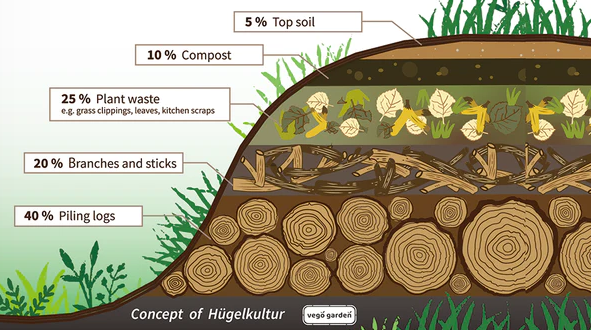
A typical Hügelkultur mound for agricultural applications. (https://richsoil.com/hugelkultur/ and https://www.sciencemill.org/blog/2023/8/12/what-is-hugelkultur)
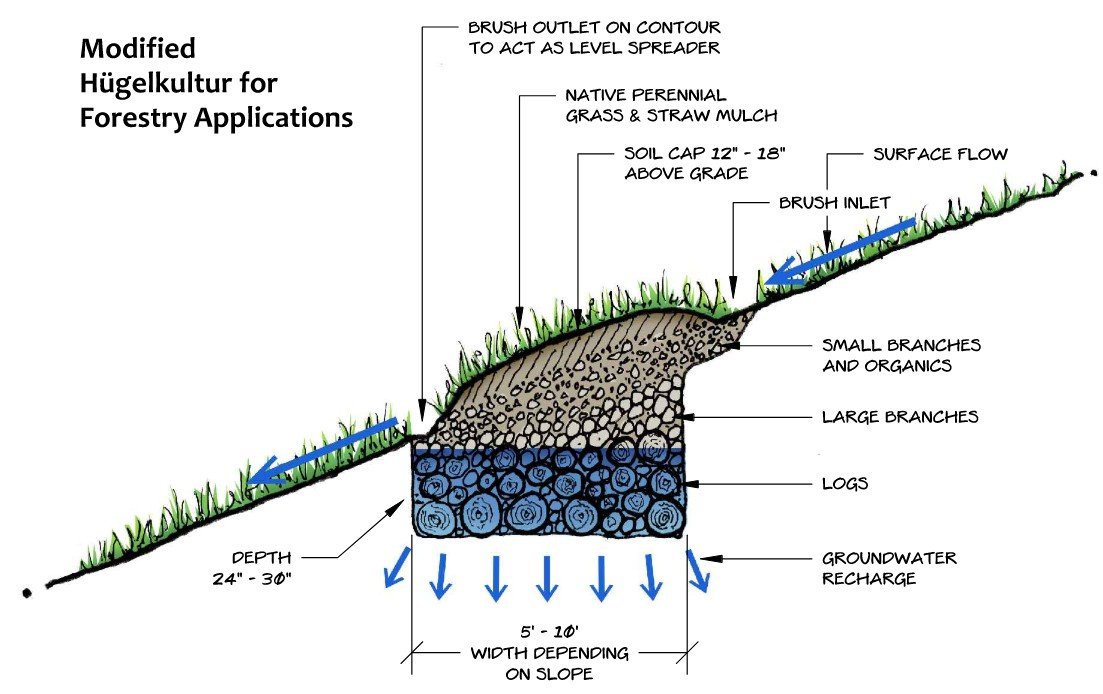
PCI’s Modified Hügelkultur for Forestry Applications conceptual design to capture surface water flow and store woody fuels beneath the ground surface (PCI, 2026).
Additional benefits can be achieved by combining modified Hügelkultur mounds with log-brush wattles.
One key benefit is the ability to slow surface flows and recharge groundwater for the area. The structures are designed to slow, spread, and sink water. Added filtration from the brushy material is designed to also improve water quality by filtering out sediment. The mounds help keep soil in place and reduce sediment delivery to nearby Ritchey and Mill Creeks and Bothe-Napa Valley State Park.
The decomposing wood will improve soil health and benefit microorganisms, and act as a mulch compost to facilitate plant establishment on barren slopes. This compost provides a nutrient-rich layer, especially necessary in barren burned areas. As new vegetation takes root, soil stability returns along slopes that once supported plant diversity and structure.
The mounds also store carbon in the form of woody biomass and anchor it to the land from which it originated. By repurposing burned debris and material generated from fuel reduction work in this way, this modified technique effectively reduces air pollution or emissions that would otherwise result from hauling material away with trucks, masticating it with equipment, or burning it in a pile.
PCI teams constructed several mounds of varying sizes on the slope. Crews strategically felled dead trees and used heavy equipment to position them parallel to slope contours before packing them with brush and soil. Each trench and mound outlet is set on contour and packed with brush to work as a level spreader for overflow conditions. Following completion of the mound and log work, crews spread weed-free rice straw and native seed across the landscape to help bolster understory plant communities and to stabilize loose soils.
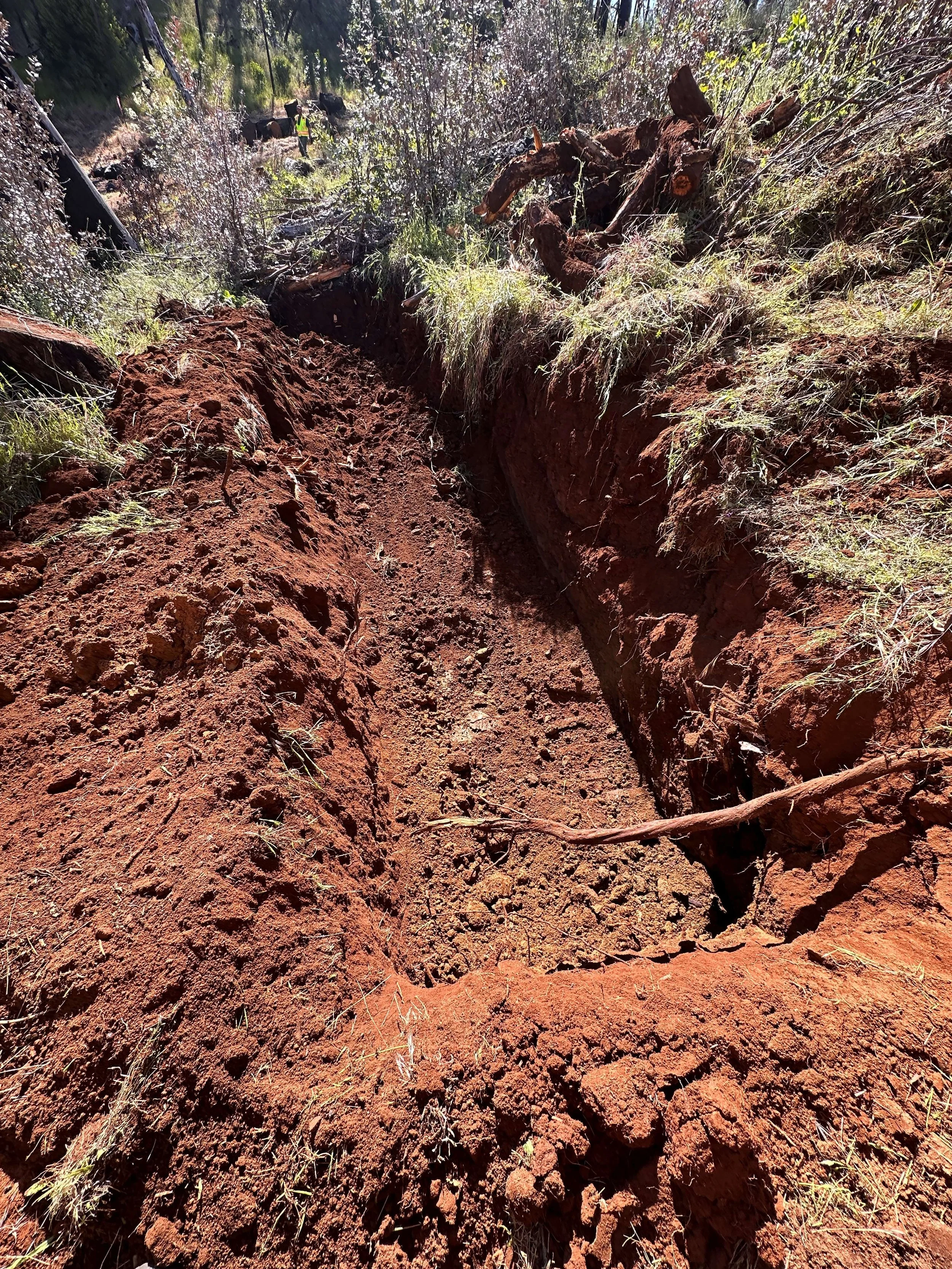
Step 1. The footprint of mound is excavated. PCI crews used an excavator for efficiency, but smaller mounds could be excavated by hand.
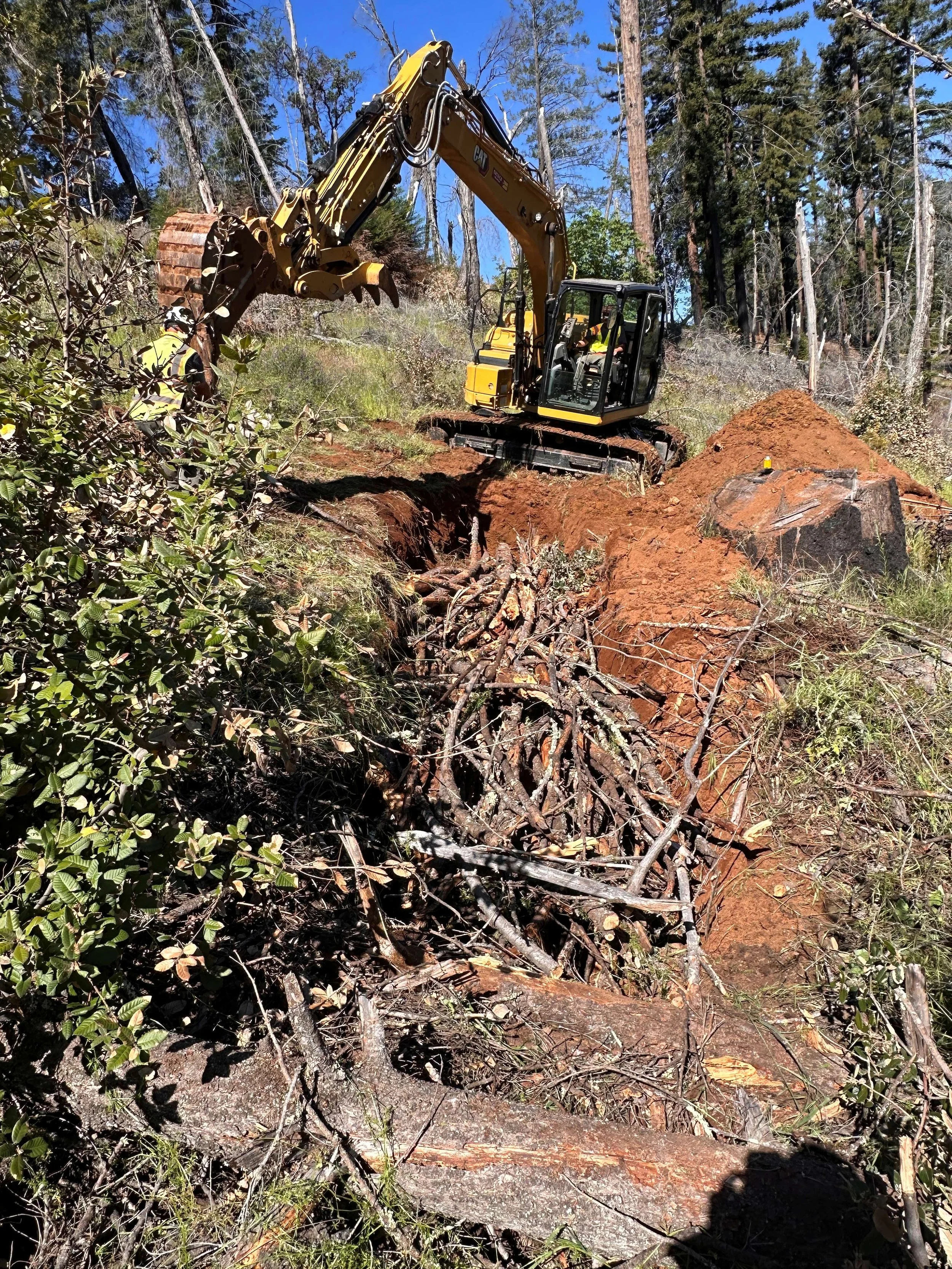
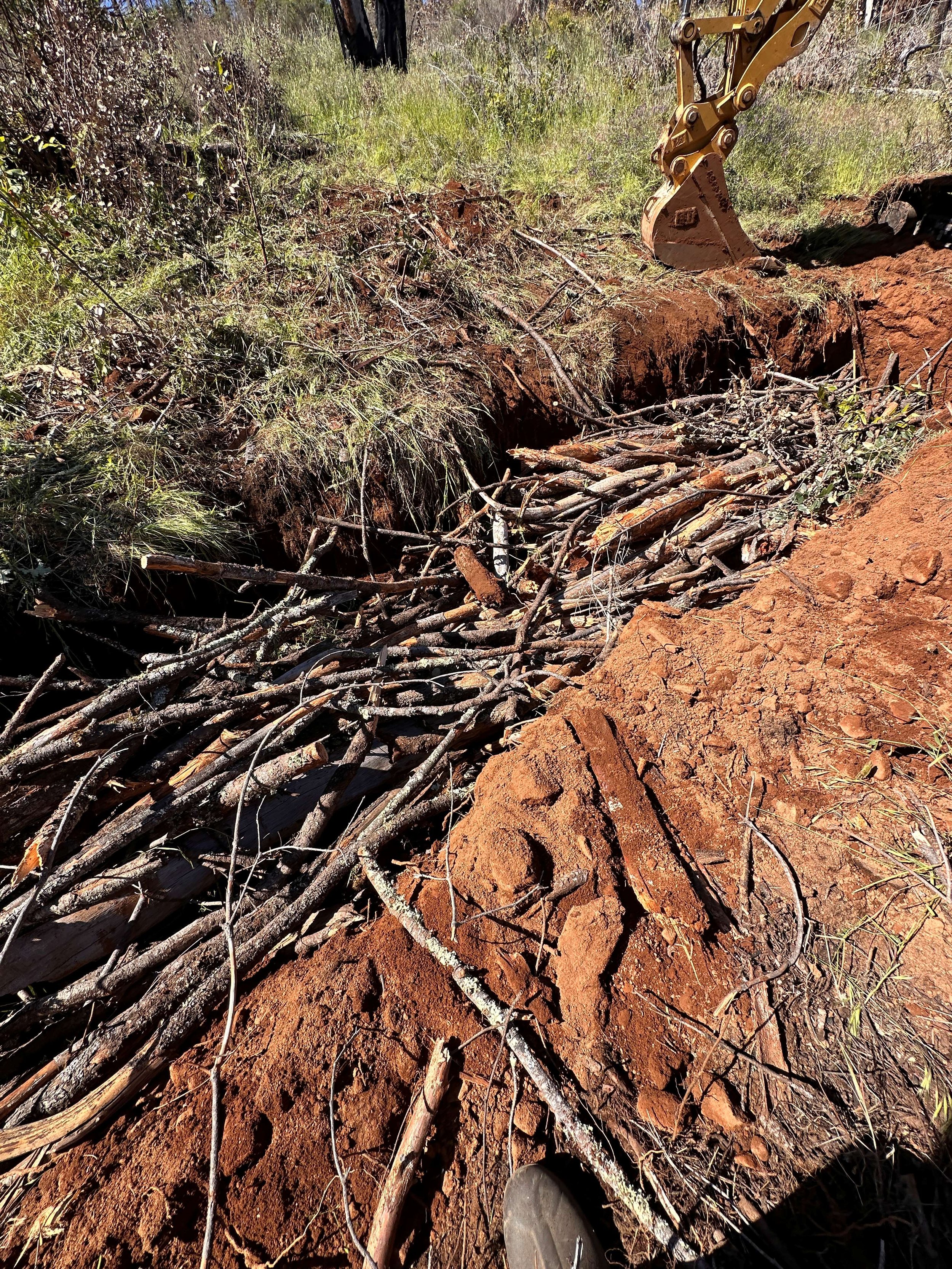
Step 2. Crews piled and consolidated downed woody debris on-site. The crews packed excavated mound footprints with this woody debris, brush, limbs, and other materials harvested from the hillside. The excavator was used to drag and move material efficiently.
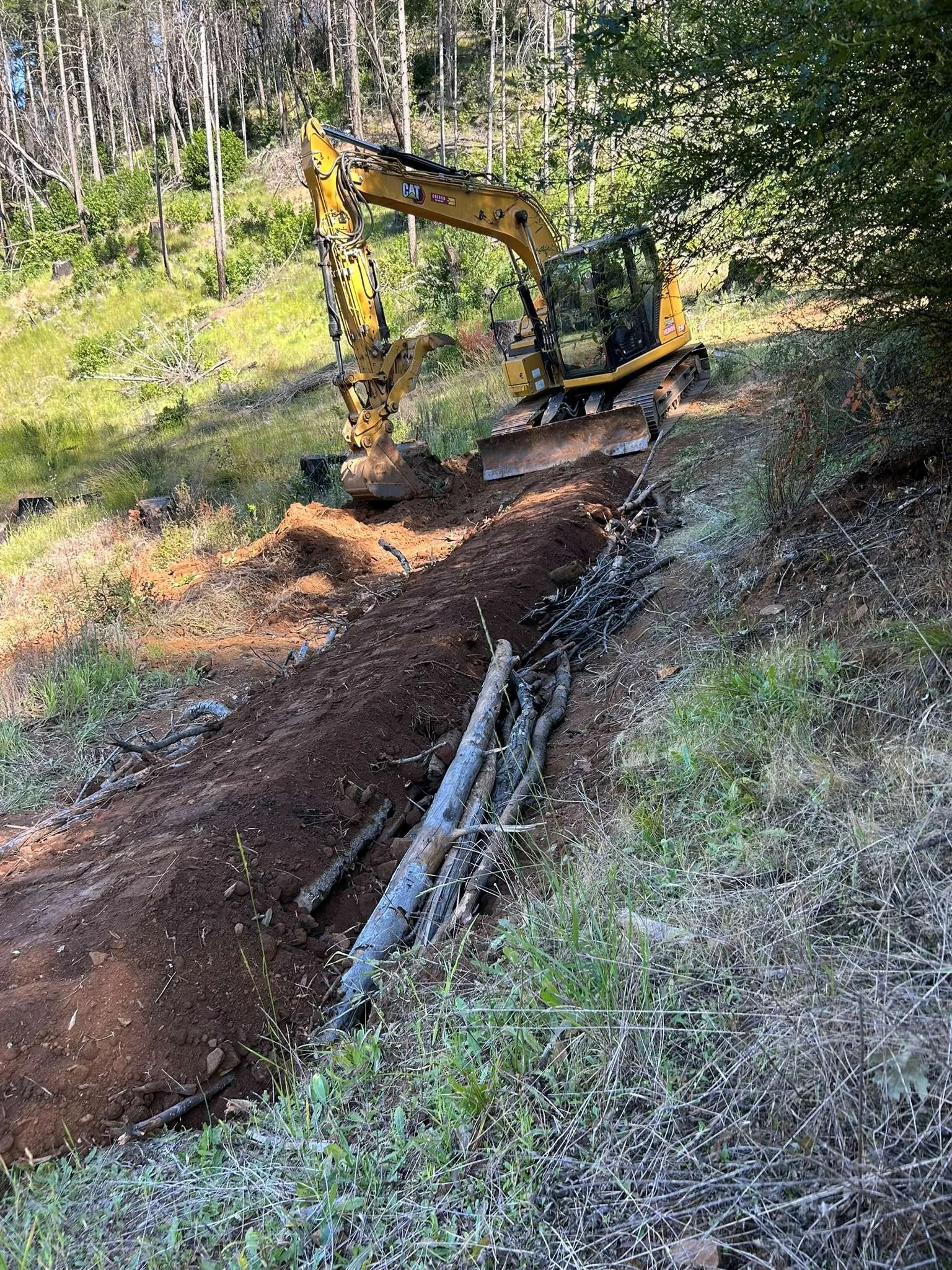
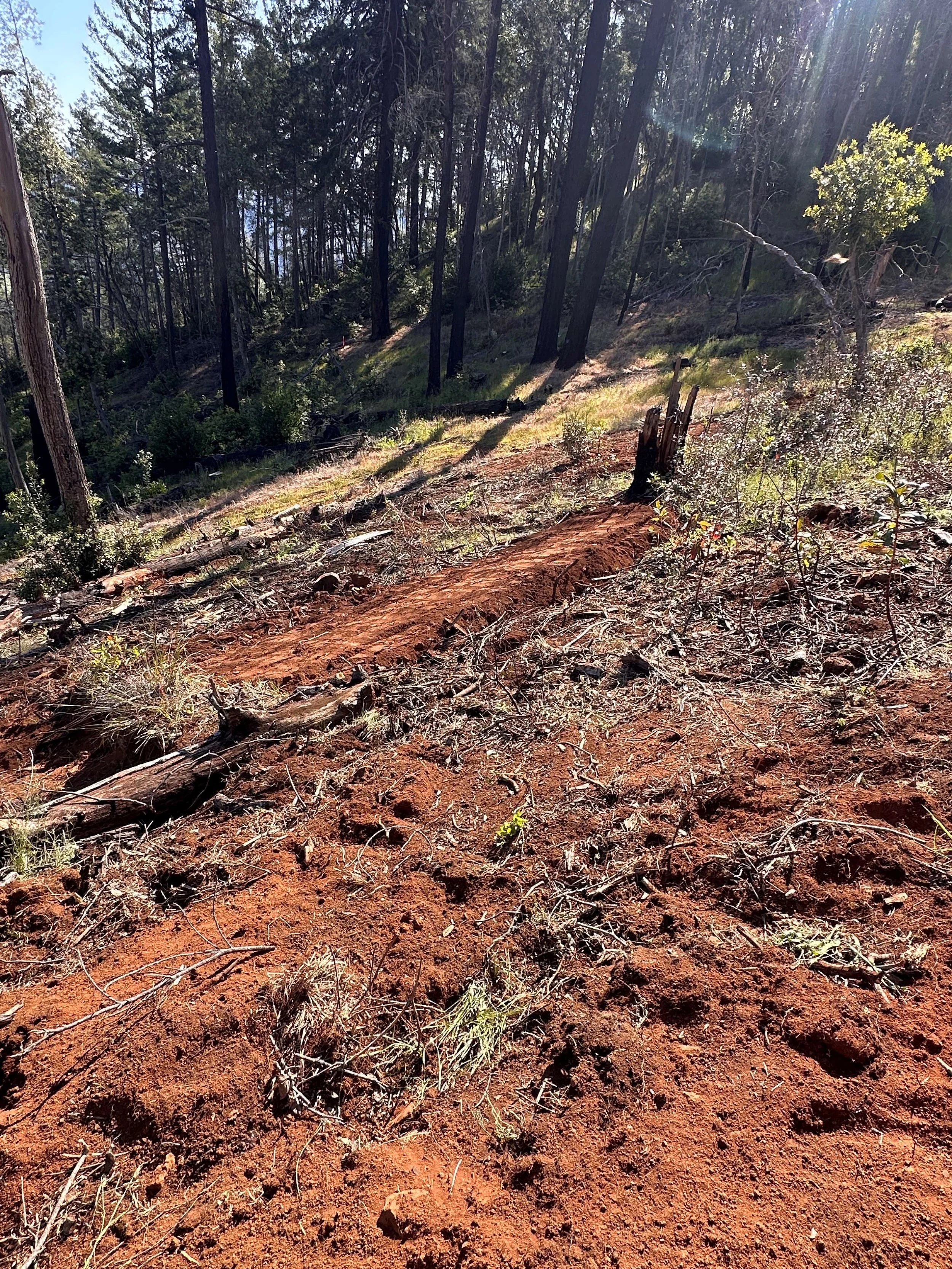
Step 3. Brush is continually packed into the footprint (as a gradient from larger diameter pieces to smaller diameter with organic debris) and then capped with soil and compacted. Logs and brush are left exposed both at the upslope and downslope edges for water to filter in and out of. This water will soak and filter into the bottom core of the mound as well and recharge groundwater.
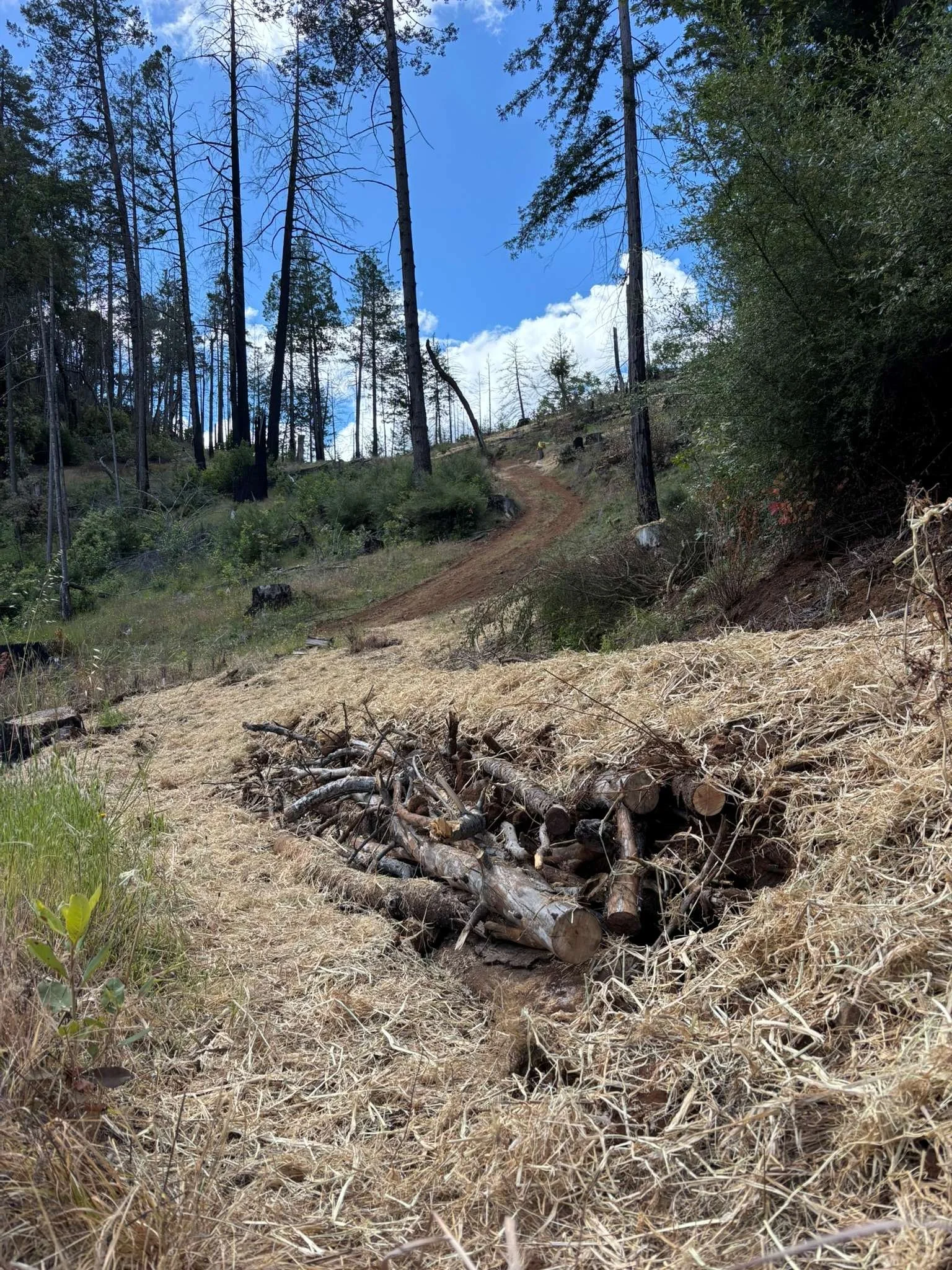
Step 4. The crews applied weed-free rice straw and native seed to all work areas. Exposed brush on the downslope side of one of the constructed mounds is visible here.
References:
Permaculture enhances carbon stocks, soil quality, and biodiversity in Central Europe. Julius Reiff, Hermann F. Jungkunst, Ken M. Mauser, Sophie Kampel, Sophie Regending, Verena Rösch, Johann G. Zaller & Martin H. Entling (July 4, 2024) Communications Earth & Environment. https://www.nature.com/articles/s43247-024-01405-8